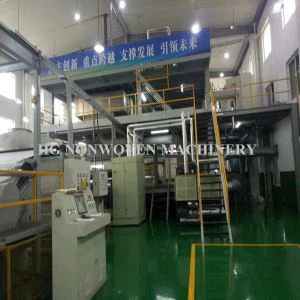
In the fiercely competitive nonwoven fabric industry, enhancing the productivity of SMS nonwoven machines while maintaining high - quality standards is a crucial goal for businesses. As a trusted SMS nonwoven machine supplier, I've witnessed firsthand the challenges and opportunities in this field. In this blog, I'll share some effective strategies to improve the productivity of SMS nonwoven machines without sacrificing quality.
1. Machine Maintenance and Optimization
Regular maintenance is the cornerstone of ensuring the smooth operation of SMS nonwoven machines. A well - maintained machine not only reduces the risk of breakdowns but also operates more efficiently. For example, the spinning system of the machine, which is responsible for creating the fiber web, needs to be inspected and cleaned regularly. Any blockages or wear in the spinnerets can lead to uneven fiber distribution, affecting both productivity and quality.
Moreover, machine optimization plays a vital role. By adjusting parameters such as the speed of the conveyor belt, the temperature of the heating system, and the pressure in the bonding process, we can achieve a balance between high - speed production and quality. For instance, increasing the conveyor belt speed can boost production volume, but if the bonding temperature is not adjusted accordingly, the nonwoven fabric may not be properly bonded, resulting in lower quality.
2. Staff Training and Skill Development
The proficiency of the operators directly impacts the productivity and quality of the SMS nonwoven machine. Well - trained staff can operate the machine more efficiently, troubleshoot problems quickly, and make timely adjustments to ensure optimal performance.
We should provide comprehensive training programs for our operators. These programs should cover not only the basic operation of the machine but also advanced skills such as parameter adjustment, quality control, and maintenance. For example, operators should be trained to identify the signs of potential problems, such as abnormal noise or vibration, and take appropriate measures to prevent major breakdowns.
In addition, encouraging continuous learning and skill development among the staff can lead to innovation in the production process. Operators may come up with new ideas to improve the efficiency of the machine or enhance the quality of the nonwoven fabric.
3. Raw Material Management
The quality of raw materials is a key factor in determining the quality of the final nonwoven fabric. As a supplier, we should work closely with reliable raw material suppliers to ensure a stable supply of high - quality materials.
Proper storage and handling of raw materials are also essential. For example, polypropylene (PP) pellets, which are commonly used in SMS nonwoven fabric production, should be stored in a dry and clean environment to prevent moisture absorption. Moisture in the raw materials can cause problems such as uneven melting and fiber breakage during the spinning process, affecting both productivity and quality.
Moreover, we can optimize the use of raw materials by implementing a just - in - time (JIT) inventory system. This system helps to reduce inventory costs and minimize waste, while ensuring that there is always an adequate supply of raw materials for production.
4. Process Automation and Control
Automation technology can significantly improve the productivity of SMS nonwoven machines. By using sensors and control systems, we can monitor and adjust the production process in real - time. For example, sensors can detect the thickness and density of the nonwoven fabric during production, and the control system can automatically adjust the machine parameters to maintain the desired quality.
In addition, automation can reduce the need for manual intervention, which not only increases productivity but also reduces the risk of human error. For instance, automated feeding systems can ensure a consistent supply of raw materials to the machine, while automated winding systems can wind the nonwoven fabric neatly and efficiently.
5. Quality Control Systems
Implementing a comprehensive quality control system is essential to ensure that the nonwoven fabric produced meets the required standards. This system should include in - process inspection and final product testing.
In - process inspection involves monitoring the production process at various stages to detect and correct any quality issues immediately. For example, using online cameras to inspect the fiber web for defects such as holes or unevenness. Final product testing, on the other hand, involves conducting a series of tests on the finished nonwoven fabric, such as strength testing, porosity testing, and moisture resistance testing.
By having a strict quality control system in place, we can ensure that the high - quality standards are maintained even when increasing the production speed.
6. Product Design and Innovation
Innovative product design can also contribute to improving the productivity of SMS nonwoven machines. By developing new types of nonwoven fabrics with unique properties, we can meet the diverse needs of customers and gain a competitive edge in the market.


For example, designing nonwoven fabrics with specific patterns or structures can increase their functionality and marketability. At the same time, new product designs may also allow for more efficient production processes. For instance, a new design that requires fewer processing steps can reduce the production time and increase productivity.
7. Collaboration and Industry Exchange
Collaborating with other manufacturers, research institutions, and industry associations can provide valuable insights and resources for improving the productivity of SMS nonwoven machines. By sharing experiences and best practices, we can learn from each other and find new ways to optimize the production process.
Industry exchange events, such as trade shows and conferences, are great opportunities to stay updated on the latest technologies and trends in the nonwoven fabric industry. We can also establish partnerships with other companies to jointly develop new products and technologies, which can lead to increased productivity and improved quality.
Conclusion
Improving the productivity of SMS nonwoven machines without sacrificing quality is a multi - faceted challenge that requires a comprehensive approach. By focusing on machine maintenance, staff training, raw material management, process automation, quality control, product design, and collaboration, we can achieve the goal of high - speed, high - quality production.
As a supplier of SMS nonwoven machines, we are committed to providing our customers with the best solutions to meet their production needs. If you are interested in our SS Nonwoven Fabric Making Machine, SS PP Spunbond Nonwoven Fabric Making Machine, or SMMS PP Nonwoven Fabric Making Machine, please feel free to contact us for further discussions and procurement. We look forward to working with you to achieve mutual success in the nonwoven fabric industry.
References
- Smith, J. (2020). Nonwoven Fabric Production: Principles and Practices. Publisher X.
- Johnson, A. (2019). Advances in Nonwoven Machine Technology. Journal of Nonwoven Science and Technology, 15(2), 78 - 90.
- Brown, C. (2021). Quality Control in Nonwoven Fabric Manufacturing. Manufacturing Review, 22(3), 45 - 56.