
As a supplier of a PP nonwoven fabric plant, I'm excited to share the detailed production process of PP nonwoven fabric with you. PP nonwoven fabric, made from polypropylene, is widely used in various industries due to its excellent properties such as high strength, good chemical resistance, and low cost.
Raw Material Preparation
The first step in the production of PP nonwoven fabric is the preparation of raw materials. Polypropylene resin is the primary raw material for this process. It is usually in the form of small pellets. These pellets are carefully selected based on their quality, melt flow index, and other properties. The melt flow index is a crucial parameter as it determines the ease of melting and processing of the polypropylene.
Before being fed into the extruder, the polypropylene pellets may be mixed with additives. These additives can enhance the performance of the final nonwoven fabric. For example, antioxidants can prevent the degradation of the polypropylene during the high - temperature processing and in the long - term use. UV stabilizers are added if the nonwoven fabric is intended for outdoor applications to protect it from the harmful effects of ultraviolet radiation.
Extrusion
Once the raw materials are prepared, they are fed into an extruder. The extruder is a key piece of equipment in the production process. It consists of a barrel and a screw. The screw rotates inside the barrel, pushing the polypropylene pellets forward. As the pellets move through the barrel, they are heated to a high temperature, typically around 200 - 250 degrees Celsius. At this temperature, the polypropylene pellets melt and form a viscous polymer melt.
The extruder also has different zones with different temperature settings. The feeding zone is at a relatively lower temperature to prevent premature melting of the pellets, while the metering zone is at a higher and more stable temperature to ensure a uniform melt. The melted polypropylene is then forced through a die at the end of the extruder. The die has a series of small holes, which shape the molten polymer into fine filaments.

Spinning
After the molten polypropylene is extruded through the die, it enters the spinning process. There are different spinning methods for PP nonwoven fabric production, such as melt - blowing and spun - bonding.
In the spun - bonding process, the extruded filaments are cooled and drawn by high - speed air currents. The filaments are stretched and oriented in the process, which increases their strength. The drawn filaments are then randomly deposited onto a moving conveyor belt to form a web. This web has a certain degree of cohesion due to the entanglement of the filaments.
The melt - blowing process, on the other hand, uses hot air jets to attenuate the extruded filaments into very fine fibers. These fine fibers are then collected on a collector screen to form a web. Melt - blown nonwoven fabrics have a much finer fiber diameter compared to spun - bonded nonwoven fabrics, which gives them unique properties such as high filtration efficiency.
Web Formation
The web formed in the spinning process is a loose assembly of filaments or fibers. To make it into a usable nonwoven fabric, it needs to be further consolidated. The random arrangement of the filaments in the web provides the basis for the fabric's isotropic properties, meaning it has similar strength and other properties in different directions.
During web formation, the filaments are continuously deposited on the conveyor belt at a controlled rate. The thickness and basis weight of the web can be adjusted by controlling the speed of the conveyor belt and the rate of filament extrusion. A thicker web will result in a heavier and stronger nonwoven fabric, while a thinner web will be lighter and more flexible.
Bonding
Bonding is the process of joining the filaments in the web together to form a cohesive nonwoven fabric. There are several bonding methods available, including thermal bonding, chemical bonding, and mechanical bonding.
Thermal bonding is one of the most common methods. In this process, the web is passed through a pair of heated calender rolls or an oven. The heat causes the surface of the filaments to soften and fuse together at the points of contact. The temperature and pressure applied during thermal bonding need to be carefully controlled to ensure proper bonding without damaging the filaments. This method is widely used because it is efficient and can produce nonwoven fabrics with good strength and dimensional stability.
Chemical bonding involves the application of a chemical binder to the web. The binder can be in the form of a liquid or a powder. After the binder is applied, the web is dried and cured. Chemical bonding can provide a high degree of bonding strength and can also impart special properties to the nonwoven fabric, such as water - repellency or flame - retardancy.
Mechanical bonding methods, such as needle punching or hydroentanglement, are also used. Needle punching uses barbed needles to mechanically entangle the filaments in the web. The needles penetrate the web repeatedly, causing the filaments to interlock. Hydroentanglement, on the other hand, uses high - pressure water jets to entangle the filaments. This method can produce nonwoven fabrics with a soft and bulky feel.
Finishing
After the bonding process, the nonwoven fabric may undergo finishing operations. Finishing can improve the appearance, performance, and functionality of the fabric.
One common finishing operation is surface treatment. For example, a hydrophobic coating can be applied to make the nonwoven fabric water - resistant. Anti - static treatment can be carried out to reduce the static electricity generated during handling and use of the fabric. Printing or embossing can also be done to add patterns or logos to the fabric, which is often required for packaging or decorative applications.
The fabric may also be cut and rolled into the desired width and length. Quality control checks are carried out at this stage to ensure that the fabric meets the required specifications in terms of strength, thickness, color, and other properties.
The Role of Machines in the Production Process
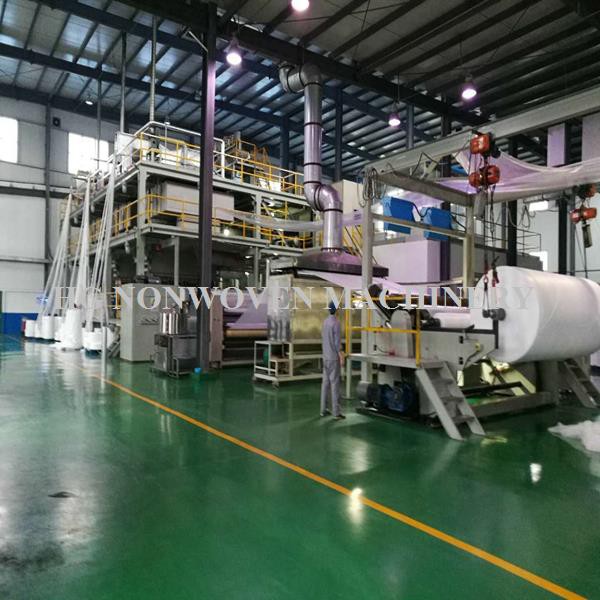
Throughout the production process, various machines play important roles. For example, the Three Beam PP Nonwoven Fabric Making Machine is a highly efficient machine that can produce high - quality PP nonwoven fabric. It integrates the functions of extrusion, spinning, and web formation, providing a seamless production process.
The Polypropylene Nonwoven Fabric Making Machine is another essential piece of equipment. It is designed to handle the polypropylene raw materials and convert them into nonwoven fabric with different characteristics. This machine can be adjusted to produce fabrics with different basis weights, thicknesses, and properties according to the specific requirements of the customers.
The Nonwoven Fabric Machine is a general - purpose machine that can perform multiple functions in the production process. It can be used for different types of nonwoven fabric production, including both spun - bonded and melt - blown processes.
Conclusion
The production process of PP nonwoven fabric in a PP nonwoven fabric plant is a complex and highly technical process that involves multiple steps from raw material preparation to finishing. Each step is crucial for ensuring the quality and performance of the final nonwoven fabric.
If you are interested in purchasing PP nonwoven fabric or learning more about our products, we welcome you to contact us for procurement negotiations. We have a wide range of high - quality PP nonwoven fabric products that can meet your various needs. Whether you need nonwoven fabric for medical, packaging, or industrial applications, we can provide you with the best solutions.
References
- “Nonwoven Fabric Handbook”
- “Polypropylene: Structure, Blends and Composites”


