



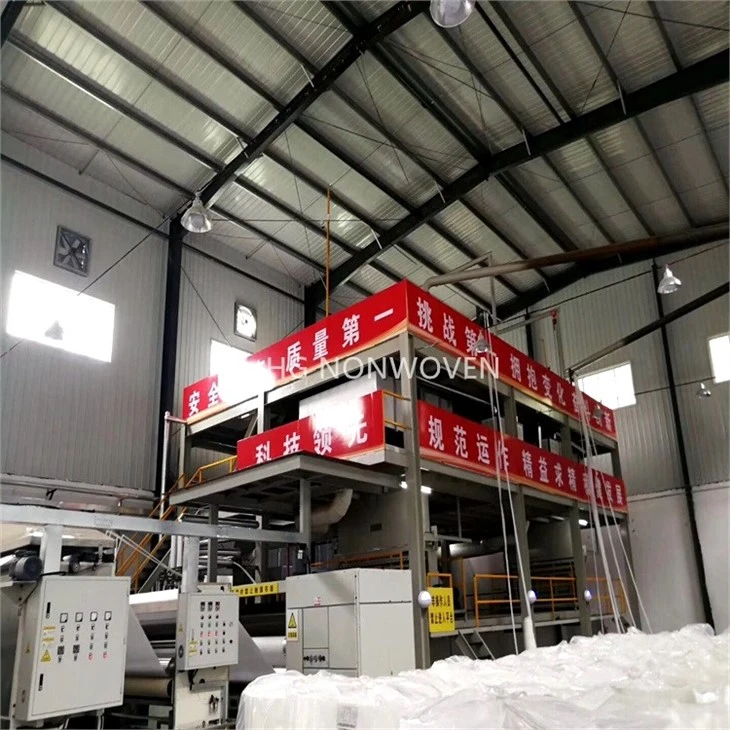
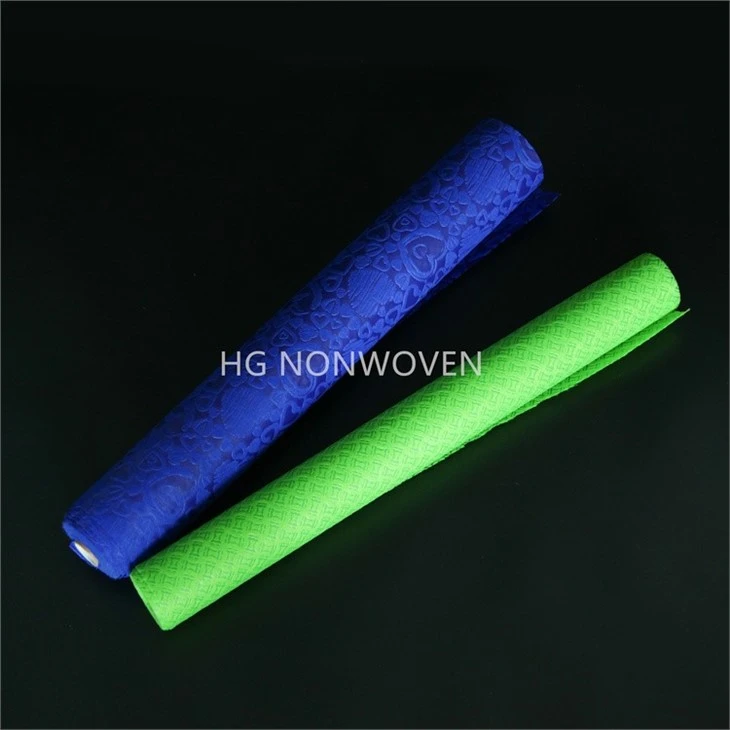


HG-2400 SMS Nonwoven Fabric Making Machine

SMS nonwoven fabric is a type of nonwoven fabric made from a combination of spunbond (S), meltblown (M), and spunbond (S) layers. The three layers are fused together using a thermal bonding process to create a material that is strong, durable, and resistant to liquids and other fluids.
SMS nonwoven fabric is commonly used in healthcare settings for protective clothing, surgical gowns, drapes, and other medical products due to its excellent barrier properties and ability to provide comfortable and breathable protection.
|
Model |
Effective width |
Daily capacity |
Speed |
Spinning system |
GSM Range |
Machine dimension Length*Width*Height |
|
HG-1600S |
1600MM |
5000Kg |
200M/Min |
Spunbond |
10-200 |
20*8*11 meter |
|
HG-2400S |
2400MM |
7000Kg |
20*11*11meter |
|||
|
HG-3200S |
3200MM |
10000Kg |
20*15*11meter |
|||
|
HG-1600SS |
1600MM |
9000Kg |
350M/Min |
Spunbond |
8-150 |
35*10*11meter |
|
HG-2400SS |
2400MM |
13000Kg |
35*12*11meter |
|||
|
HG-3200SS |
3200MM |
16000Kg |
35*15*11meter |
|||
|
HG-1600SSS |
1600MM |
12000Kg |
400M/Min |
Spunbond |
8-100 |
40*10*11meter |
|
HG-2400SSS |
2400MM |
16000Kg |
40*12*11meter |
|||
|
HG-3200SSS |
3200MM |
23000Kg |
40*15*11meter |
|||
|
HG-1600SSS |
1600MM |
12000Kg |
400M/Min |
Spunbond |
8-100 |
40*10*11meter |
|
HG-2400SSS |
2400MM |
16000Kg |
40*12*11meter |
|||
|
HG-3200SSS |
3200MM |
23000Kg |
40*15*11meter |
|||
|
HG-1600SMS |
1600MM |
10000Kg |
400M/Min |
Spunbond/ Meltblown/ Spunbond |
8-80 |
40*15*11meter |
|
HG-2400SMS |
2400MM |
14000Kg |
40*18*11meter |
|||
|
HG-3200SMS |
3200MM |
18000Kg |
40*25*11meter |
|||
|
HG-1600SMMS |
1600MM |
12000Kg |
500M/Min |
Spunbond/Meltblown/Meltblown/Spunbond |
8-80 |
45*15*11meter |
|
HG-2400SMMS |
2400MM |
17000Kg |
45*18*11meter |
|||
|
HG-3200SMMS |
3200MM |
23000Kg |
45*25*11meter |

1. HG-2400 SMS - Complete Technical Specifications
| Parameter | HG-2400 SMS |
|---|---|
| Model | HG-2400 SMS |
| Spinning System | SMS - Spunbond + Meltblown + Spunbond (3 beams: S1 + M1 + S2) |
| Effective Width | 2,400 mm |
| Production Speed (max) | 400 m/min (theoretical); 250–350 m/min sustained at typical weights |
| Daily Output | 14,000 kg (14 tons) |
| Annual Output | ≈ 4,600 tons/year (330 days × 14t) |
| Fabric Weight Range | 8 – 80 g/m² |
| Spunbond Extruders | 2 × Ø150mm, L/D = 30:1 |
| Meltblown Extruder | 1 × Ø120mm, L/D = 28:1 |
| Total Extruders | 3 (2 spunbond + 1 meltblown) |
| Spunbond Melt Temperature | 180 – 230°C |
| Meltblown Melt Temperature | 200 – 260°C |
| Spunbond Filament Denier | 1.6 – 2.0 den |
| Meltblown Fiber Diameter | 2 – 5 μm (microfibers) |
| Meltblown Fiber Denier | 0.01 – 0.5 den |
| Spunbond Spinneret Holes | 3,000 – 5,000 holes/m per beam |
| Meltblown Die Width | ≈ 2,400 mm |
| Installed Power | ≈ 1,250 kVA |
| Running Power Consumption | ≈ 700 – 1,000 kW |
| Specific Energy | ≈ 1,200 – 1,600 kWh/ton |
| Machine Dimensions (L×W×H) | 40 × 18 × 11 m |
| Machine Footprint | ≈ 720 m² |
| Calender Type | Heated double-roll, thermal oil, 130–160°C, line pressure 80–150 N/mm |
| Winding System | Fully automatic, auto splicing, max roll Ø 2,000 mm, roll weight up to 3.5 tons |
| PLC / HMI | Siemens S7-1500 PLC + WinCC HMI |
| Surface Inspection | In-line camera-based defect detection (holes, spots, gels, weight variation) |
| Operators per Shift | 5 – 6 |
| Raw Material | Spunbond: PP homopolymer, MFI 25–40 g/10min; Meltblown: PP, MFI 800–2,000 g/10min |
| Screen Changer | Dual-column, 250-mesh, for each extruder |
| Melt Pump | 3 gear pumps (one per beam), pressure fluctuation ≤ ±0.5% |
2. Configuration Comparison at 2,400mm Width - SMS vs SMMS vs SSS
| Parameter (at 2400mm) | HG-2400 SS | HG-2400 SMS | HG-2400 SSS | HG-2400 SMMS |
|---|---|---|---|---|
| Beam Configuration | S1 + S2 | S1 + M1 + S2 | S1 + S2 + S3 | S1 + S2 + M1 + M2 |
| Total Beams | 2 spunbond | 2 SB + 1 MB | 3 spunbond | 2 SB + 2 MB |
| Daily Output | 13 t | 14 t | 16 t | 17 t |
| Line Speed (max) | 350 m/min | 400 m/min | 400 m/min | 500 m/min |
| Installed Power | ≈ 350 kVA | ≈ 1,250 kVA | ≈ 800 kVA | ≈ 1,700 kVA |
| Specific Energy | 800–1,000 kWh/t | 1,200–1,600 kWh/t | 1,000–1,200 kWh/t | 1,400–2,000 kWh/t |
| Min. Fabric Weight | 8 g/m² | 8 g/m² | 8 g/m² | 8 g/m² |
| Max. Fabric Weight | 150 g/m² | 80 g/m² | 100 g/m² | 80 g/m² |
| Barrier Properties (BFE) | None | ≥ 95% | None | ≥ 99% |
| Hydrostatic Head | N/A | ≥ 20–60 cm H₂O | N/A | ≥ 40–100 cm H₂O |
| Extruder Count | 2 | 3 | 3 | 4 |
| Machine Length | 35 m | 40 m | 40 m | 45 m |
| Machine Width | 12 m | 18 m | 12 m | 18 m |
| Investment Range | $350K–450K | $800K–1.2M | $500K–650K | $1.2M–1.8M |
| Best For | Hygiene, packaging - no barrier | Surgical gowns, masks, diapers - barrier | Premium hygiene - high output, no barrier | Premium medical - highest barrier |
3. SMS Production Process - 10 Steps (S1 + M1 + S2)
| Step | Process Stage | Technical Details |
|---|---|---|
| 1 | Polymer Preparation (×2 types) | Spunbond resin: PP homopolymer chips, MFI 25–40 g/10min → 2 hoppers for S1 & S2. Meltblown resin: PP with MFI 800–2,000 g/10min → 1 hopper for M1. Color masterbatch and additives dosed by gravimetric metering (±0.5%) |
| 2 | Triple Melting & Extrusion | 3 independent extruders: 2 × spunbond (Ø150mm, L/D=30:1) + 1 × meltblown (Ø120mm, L/D=28:1). Spunbond melt at 180–230°C; meltblown melt at 200–260°C. Each extruder has 6 heating zones with PID control (±1°C). Melt filtered through 250-mesh dual-column screen changer |
| 3 | Precision Metering (×3) | 3 gear melt pumps maintain constant melt pressure (10–20 MPa); pressure fluctuation ≤ ±0.5%; ensures uniform filament/fiber denier across full 2,400mm width |
| 4 | S1 Spinning (Spunbond Beam 1) | S1 spinneret (3,000–5,000 holes/m) extrudes continuous PP filaments; filament denier 1.6–2.0 den |
| 5 | S1 Quenching & Drawing | Conditioned cross-flow air (20–25°C, 50–65% RH) cools S1 filaments; drawn by high-velocity suction air; deposited randomly onto forming wire as Layer 1 |
| 6 | M1 Spinning (Meltblown Beam) | M1 die (multi-row spinneret, 0.2mm capillary holes) extrudes molten PP; high-velocity hot air (250–320°C, 0.3–0.8 MPa) attenuates filaments into microfibers (2–5 μm); deposited onto S1 web as Layer 2 |
| 7 | S2 Spinning (Spunbond Beam 2) | S2 spinneret (3,000–5,000 holes/m) extrudes continuous PP filaments; quenched and drawn; deposited onto M1 layer as Layer 3 - completing the SMS sandwich structure (S1+M1+S2) |
| 8 | Thermal Bonding | Triple-layer web passes through heated double-roll calender (thermal oil, 130–160°C); S-roll deflection compensation for uniform bonding across 2,400mm width; line pressure 80–150 N/mm |
| 9 | Surface Inspection | In-line camera-based defect inspection system detects holes, spots, gels, and weight variations in real time; data logged for quality traceability |
| 10 | Winding & Slitting | SMS fabric wound onto parent roll (max. Ø 2,000mm); in-line edge slitting; automatic splicing for continuous production; roll weight up to 3.5 tons |
4. Meltblown Section - Critical Technical Parameters (HG-2400 SMS)
| Parameter | Specification |
|---|---|
| Meltblown Screw Diameter | Ø120 mm |
| Screw L/D Ratio | 28:1 |
| MB Resin MFI | 800 – 2,000 g/10min (high-flow PP) |
| MB Melt Temperature | 200 – 260°C (higher than spunbond due to high MFI) |
| Hot Air Temperature | 250 – 320°C |
| Hot Air Pressure | 0.3 – 0.8 MPa |
| Hot Air Volume | 1,800 – 2,500 m³/h |
| Air Heater Power | 80 – 120 kW |
| Air Compressor Power | 50 – 100 kW |
| Fiber Diameter | 2 – 5 μm (microfibers) |
| Fiber Denier | 0.01 – 0.5 den |
| Die Tip to Collector Distance (DCD) | 150 – 300 mm (adjustable) |
| MB Die Width | ≈ 2,400 mm |
| Capillary Hole Diameter | 0.2 mm (multi-row configuration) |
| MB Output per Hour | 80 – 160 kg/h |
| MB Section Power Consumption | 200 – 400 kW (air heater + compressor + extruder) |
| Exhaust / Ventilation Required | ≥ 20,000 m³/h local exhaust for hot air discharge |
5. SMS Fabric Quality Parameters
| Property | Test Method | SMS (15 g/m²) | SMS (25 g/m²) | SMS (40 g/m²) |
|---|---|---|---|---|
| Tensile Strength (MD) | ISO 9073-3 | ≥ 25 N/5cm | ≥ 40 N/5cm | ≥ 60 N/5cm |
| Tensile Strength (CD) | ISO 9073-3 | ≥ 15 N/5cm | ≥ 25 N/5cm | ≥ 40 N/5cm |
| MD/CD Ratio | ISO 9073-3 | 1.5 – 1.7 | 1.4 – 1.6 | 1.3 – 1.5 |
| Elongation at Break | ISO 9073-3 | 40 – 80% | 45 – 100% | 50 – 120% |
| Weight Uniformity (CV) | ISO 9073-1 | ≤ 4% | ≤ 3.5% | ≤ 3% |
| Bacterial Filtration Efficiency (BFE) | ASTM F2101 | ≥ 95% | ≥ 98% | ≥ 99% |
| Particle Filtration Efficiency (PFE) | ASTM F2299 (0.1μm) | ≥ 90% | ≥ 95% | ≥ 98% |
| Hydrostatic Head | AATCC 127 | ≥ 20 cm H₂O | ≥ 40 cm H₂O | ≥ 60 cm H₂O |
| Air Permeability | ISO 9237 | 200–500 L/m²/s | 80–250 L/m²/s | 30–100 L/m²/s |
| Softness (Handle-O-Meter) | Handle-O-Meter | ≤ 2.5 gf | ≤ 3.5 gf | ≤ 5.0 gf |
| Linting (Dry) | ISO 9073-10 | ≤ 4.0 mg | ≤ 3.0 mg | ≤ 2.0 mg |
| Fiber Composition | FTIR analysis | 100% Polypropylene (spunbond layers + meltblown layer) | ||
6. Factory Infrastructure Requirements for HG-2400 SMS
| Requirement | Specification |
|---|---|
| Factory Length | ≥ 45 m (40m machine + 5m clearance for winder + utility) |
| Factory Width | ≥ 24 m (18m machine + 6m for maintenance access + electrical) |
| Factory Height | ≥ 12 m (meltblown die + hot air system require overhead clearance) |
| Overhead Crane | 10 – 15 ton (for spinneret installation and meltblown die handling) |
| Power Supply | 1,250 kVA (transformer + switchgear rated accordingly) |
| Compressed Air (General) | 0.6 – 0.8 MPa |
| Compressed Air (Meltblown) | 1,800 – 2,500 m³/h at 0.3 MPa (dedicated system) |
| Cooling Water | ≥ 65 m³/h (chiller or cooling tower) |
| Thermal Oil System | For calender heating (130–160°C); capacity scaled to 2,400mm width |
| Exhaust / Ventilation | Meltblown section requires local exhaust ≥ 20,000 m³/h for hot air discharge |
| Floor Load | ≥ 8 tons/m² (meltblown die + calender are heavy point loads) |
| HVAC for Clean Area | Recommended for medical/hygiene fabric production; temp 22±2°C, humidity 55±5% |
| Raw Material Storage | Dry, dust-free area for PP chips; separate zones for spunbond and meltblown resins |
7. Raw Material & Additives Guide for HG-2400 SMS
| Material Type | Specification | Used In | Dosage |
|---|---|---|---|
| PP Homopolymer (Spunbond) | MFI 25–40 g/10min (230°C / 2.16kg, ASTM D1238); density 0.91 g/cm³; isotactic index ≥ 95% | S1 + S2 beams | 70–85% of total |
| PP Meltblown Grade | MFI 800–2,000 g/10min; narrow molecular weight distribution; low ash content | M1 beam | 10–20% of total |
| Color Masterbatch | PP-based carrier; carbon black or pigment; MFI matched to base resin | All beams | 0.5 – 3% |
| Hydrophilic Agent | Surfactant-based masterbatch; reduces contact angle for hygiene fabrics | Usually S1 (top layer) | 1 – 3% |
| Anti-UV Stabilizer | HALS (hindered amine light stabilizer) + UV absorber; for agricultural fabrics | All beams | 1 – 5% |
| Flame Retardant | Halogen-free intumescent (APP/PER system); for furniture/automotive | All beams | 3 – 8% |
| Anti-Static Agent | Glycerol monostearate or ethoxylated amine masterbatch | Usually S2 (bottom) | 1 – 3% |
| Anti-Bacterial Agent | Ag+ ion or ZnO nanoparticle masterbatch; for medical fabrics | Usually M1 (middle barrier layer) | 0.5 – 2% |
| Softness Agent | Silicone-based or polyethylene wax masterbatch; improves drape and handle | S1 + S2 | 0.5 – 2% |
8. Commercial Terms & Project Timeline
| Item | Details |
|---|---|
| Manufacturing Lead Time | 90 days |
| Installation & Commissioning | 60 – 80 days |
| Operator Training | 5 – 10 days on-site |
| Total Project Duration | ≈ 6 – 7 months (order to production) |
| Warranty Period | 12 – 24 months from installation date |
| Spare Parts Package | 1-year supply included with delivery |
| Service Model | Turn-key: design → manufacturing → installation → training → production handover |
| After-Sales Support | Remote technical support (24/7) + on-site maintenance + spare parts supply |
| Payment Terms | 30% T/T advance + 70% before shipment (or L/C at sight) |
| Investment Range | $800K – $1.2M (machine line only, excluding factory preparation) |
| Global Track Record | 300+ lines installed in 20+ countries |
| Factory Acceptance Test (FAT) | Buyer visits HG factory for pre-shipment inspection; production trial run + fabric testing |
Nonwoven fabric is lightweight, soft, and gentle on the skin, making it ideal for use in personal care and hygiene products, such as diapers and feminine care products.
Nonwoven fabric has excellent absorbent properties, making it suitable for use in absorbent products such as surgical gowns, wipes, and filtration media.
Nonwoven fabric is highly breathable, allowing air and moisture to pass through, making it comfortable to wear in hot and humid conditions.


Why Choose Us
20+
HG Nonwoven fabric making machines have already successfully exported to 20+ countries and regions which made HG nonwoven famous and won the good reputation.
300+
HG Nonwoven have already successfully installed more than 300+ nonwoven fabric production lines around the world and keeps growing in good growth rate every year.


FAQ
Q: What does SMS stand for in the name of this machine HG-2400 SMS Nonwoven Fabric Making Machine?
A: SMS means Spunbond + Meltblown + Spunbond, so it is a 3-beam line (S1 + M1 + S2). It will produce spunbond nonwoven fabric from two beams of spunbond and one beam of meltblown. Spunbond will make long filament while meltblown will produce fiber less than 5 micron diameter. The fabric produced by SMS will have BFE greater than 95% and Hydrostatic head more than 20 CM water column. There is one error in this web page description which says this machine has "three layers of spunbond with one layer of meltblown". Actually the SMS machine only has two layers of spunbond and one layer of meltblown. This should be amended in the website.
Q: I can see there are 21 sets of parameters in the table. Which set is applicable to this machine?
A: The set of parameter applicable for this web page is HG-2400 SMS. All other 20 sets of parameters are not for this machine. We just included those for your reference. Also there are two similar parameters of SSS in the table. The correct data sheet for HG-2400 SMS please refer Table 1.
Q: What is the installed power of the machine and how much energy will it consume?
A: As far as I know other Chinese manufacturers like AoLong, Yanpeng and others have similar machines of 2400 mm width for SMS. Their installed power is around 1250 KVA and running consumption is around 700 - 1000 KW. Specific energy is about 1200 - 1600 KWH/ton. One important point to note here is the Melt blown section will require an extra 200 - 400 KW for Air heater (80-120 KW) and Air Compressor (50-100 KW) plus Melblown extruder. You may check with the supplier for more information. There is no data mentioned in this web page.
Q: I noticed the line speed is mentioned as 400 Meters per minute. Is it possible?
A: The machine manufacturer HG Machinery has stated 400 Meters per minute for their SMS machine. Normally the line speed for these kind of machine from China is maximum 350 meters per minute. So we assume 400 meters per minute could be the maximum speed if you produce very light GSM using good material. But average production speed could be less. Please confirm with HG Machinery for more details.
Q: What is Melt Blown section and what else I need to prepare in my factory for that?
A: The Melt blown section (M1) in SMS machine will produce very fine fiber using Hot Air at High Velocity. So you will need good Air Compressor setup with High Volume. The hot air requirement is approx. 1800 - 2500 M3/hour at Pressure of 0.3 - 0.8 MPa. Temperature will be 250 - 320 deg C. So you need to plan for this in your factory. Refer Table 4 and Table 6 for more detail.
Q: How HG-2400 SMS is different from HG-2400 SMMS?
A: HG-2400 SMS will have 2 spunbond layer and 1 meltblown layer. It will produce 14 tons per day and BFE greater than 95%. Hydrostatic head will be more than 20 CM Water Column. If you want to produce 17 tons per day with BFE greater than 99% then you will need to go for HG-2400 SMMS. In SMMS machine there will be 2 spunbond layer and 2 meltblown layer. So you will need to install an additional meltblown section and will require approx. 400 KVA more power and additional 5 meter length in machine and 1000 M3/hr more volume of hot air. If you are going to produce Surgical Gown and Face Mask (Normal type) then SMS will be good enough.
Q: Can I upgrade my SMS machine to SMMS in future?
A: Yes you can. Just need to install one more meltblown section in your existing SMS machine. You will need some space in your factory. Also you will have to install additional Air Compressor and Heater of approx. 1000 M3/hr and 60 - 80 KW. More ventilation facility is required. Total cost could be around USD 300,000 - 500,000 depending on your requirement.
Q: What certification do I need to comply with for Medical use?
A: If you are going to produce Surgical Gown you should comply with EN 13795 or AAMI PB70 standard. For face mask EN 14683 is the standard. There are different types of face mask. Type 1 will have BFE greater than 95%. Type 2 will have BFE greater than 98% and Type 1IR will have splash protection. For medical wrapping you should follow ISO 11607 standard. Your SMS machine should be able to produce fabric which meets following criteria. BFE > 95% (ASTM F2101), Hydrostatic Head > 20 CM water column (AATCC 127), Linting < 4.0 MG (ISO 9073 - 10). Please ask the supplier to provide you the lab report of the fabric they can produce.
Q: What size of factory will I need to install this machine?
A: You will need minimum 45 Meter length x 24 Meter wide x 12 Meter Height of factory. Floor loading should be min. 8 tons/sqm. Over head Crane of 10 - 15 ton is recommended. Power supply 1250 KVA. Compressed Air 0.6 - 0.8 MPa. Cooling water 65 M3/hr. Ventilation system of 20000 M3/hr will be needed for the Melt blown section. You may get the factory layout from HG Machinery. They will help you to design the plant. Refer Table 6 for more details.
Google Website:www.hgnonwoventech.com
Alibaba Website: https://pjhaigong.en.alibaba.com
Facebook:www.facebook.com/hgnonwoven/
YouTube:www.youtube.com/@leoliu3636
Hot Tags: hg-2400 sms nonwoven fabric making machine, China, suppliers, manufacturers, factory, rivet pp spunbond nonwoven machinery, hook pp spunbond nonwoven machinery, pump pp spunbond nonwoven machinery, suit pp spunbond nonwoven machinery, pp nonwoven fabric machine for transformer, raincoat pp spunbond nonwoven machinery
You Might Also Like


Send Inquiry