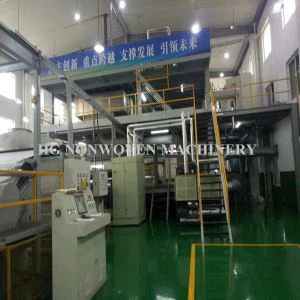
Hey there! As a supplier of PP Nonwoven Fabric Making Machines, I get a bunch of questions from customers all the time. One of the most common ones is about how to adjust the distance between the spinneret and the collector in these machines. So, I thought I'd write this blog to share some tips and insights on this topic.
Why is the Distance between Spinneret and Collector Important?
Before we dive into the how - to part, let's quickly talk about why this distance matters. The distance between the spinneret and the collector plays a crucial role in determining the quality of the PP nonwoven fabric produced. A proper distance ensures uniform fiber deposition, which in turn affects the fabric's strength, thickness, and overall appearance.


If the distance is too short, the fibers won't have enough time to cool and solidify properly. This can lead to fibers sticking together, resulting in a non - uniform fabric with poor strength. On the other hand, if the distance is too long, the fibers may lose too much energy and not form a proper web, leading to a thin and weak fabric.
Factors to Consider Before Adjusting the Distance
There are several factors you need to take into account before making any adjustments to the distance between the spinneret and the collector.
1. Polymer Properties
The type of polypropylene used in the machine has a big impact. Different grades of PP have different melting points, viscosity, and cooling rates. For example, a high - viscosity PP may require a longer distance to allow for proper stretching and cooling of the fibers.
2. Production Speed
The speed at which the machine is running also matters. Higher production speeds generally require a shorter distance between the spinneret and the collector. This is because at high speeds, the fibers need to be deposited on the collector quickly to maintain the production rate.
3. Desired Fabric Characteristics
If you're aiming for a thicker and stronger fabric, you may need to adjust the distance accordingly. A shorter distance can result in a denser web, while a longer distance can produce a more open - structured fabric.
How to Adjust the Distance
Now, let's get to the main part - how to actually adjust the distance. Most modern PP Nonwoven Fabric Making Machines come with an adjustable mechanism for this purpose.
Step 1: Review the Machine Manual
First things first, grab the machine manual. It will have specific instructions on how to access and adjust the distance between the spinneret and the collector. The manual will also provide the recommended distance range based on different production parameters.
Step 2: Power Off the Machine
For safety reasons, make sure the machine is turned off before you start making any adjustments. This will prevent any accidental start - up that could cause injury.
Step 3: Locate the Adjustment Mechanism
The adjustment mechanism can vary depending on the model of the machine. It could be a set of screws, a hydraulic system, or an electronic control. Look for the part of the machine that is responsible for changing the position of the spinneret or the collector.
Step 4: Make Small Adjustments
Once you've located the adjustment mechanism, start making small changes to the distance. It's better to make small adjustments and then test the fabric quality than to make large changes all at once. After each adjustment, run a short production run and check the quality of the fabric.
Step 5: Monitor the Fabric Quality
Pay close attention to the fabric characteristics such as strength, thickness, and uniformity. If the fabric quality is not up to par, make further small adjustments until you achieve the desired results.
Step 6: Document the Changes
It's a good idea to keep a record of the adjustments you make. This will help you in future production runs and troubleshooting. Note down the initial distance, the adjustments made, and the resulting fabric quality.
Tools and Equipment for Adjustment
In some cases, you may need specific tools to make the adjustments. Here are some common tools:
- Screwdrivers: If the adjustment mechanism involves screws, you'll need the appropriate screwdrivers to loosen or tighten them.
- Wrenches: For nuts and bolts, wrenches are essential. Make sure you have the right size wrenches for the job.
- Measuring Tools: A ruler or a caliper can be used to measure the distance accurately. This is important to ensure that the distance is within the recommended range.
Troubleshooting
If you encounter problems during the adjustment process, here are some common issues and solutions:
1. Non - Uniform Fiber Deposition
If the fibers are not being deposited uniformly on the collector, it could be due to an improper distance. Check the distance again and make small adjustments. It could also be caused by a blocked spinneret, so inspect the spinneret for any clogs.
2. Weak Fabric
A weak fabric may indicate that the fibers are not bonding properly. Try reducing the distance slightly to allow for better fiber entanglement. Also, check the temperature settings of the machine as incorrect temperatures can affect fiber strength.
3. Excessive Fiber Breakage
If you notice a lot of fiber breakage, it could be because the distance is too long. The fibers may be losing too much energy before reaching the collector. Shorten the distance and see if the problem improves.
Conclusion
Adjusting the distance between the spinneret and the collector in a PP Nonwoven Fabric Making Machine is a crucial step in producing high - quality nonwoven fabrics. By considering factors like polymer properties, production speed, and desired fabric characteristics, and following the proper adjustment steps, you can ensure optimal fabric quality.
If you're in the market for a reliable PP Nonwoven Fabric Making Machine, PP Nonwoven Fabric Plant or PP Spunbond Non Woven Fabric Production Line, we've got you covered. Our machines are designed with user - friendly adjustment mechanisms to make the process as easy as possible.
If you have any questions, need more information, or are interested in purchasing our products, don't hesitate to reach out to us. We're here to help you make the most of your nonwoven fabric production.
References
- Industry - standard nonwoven fabric manufacturing guides.
- Technical manuals of PP nonwoven fabric making machines.