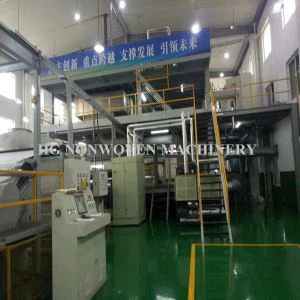
Improving the quality of nonwoven fabrics produced by a PP nonwoven fabric making machine is a crucial concern for manufacturers aiming to meet market demands and enhance competitiveness. As a trusted supplier of PP Nonwoven Fabric Making Machines, I understand the significance of delivering high - quality products. In this blog, I will share some effective strategies and techniques to elevate the quality of nonwoven fabrics.
1. Raw Material Selection
The quality of raw materials is the foundation of high - quality nonwoven fabrics. Polypropylene (PP) resin, the main raw material for PP nonwoven fabrics, should be carefully chosen. Opt for high - grade PP resins with consistent melt flow rates (MFR). A stable MFR ensures uniform melting and extrusion during the manufacturing process, which is essential for the even distribution of fibers in the nonwoven fabric.
For instance, a resin with a fluctuating MFR may result in uneven fiber thickness, leading to inconsistent fabric strength and appearance. Additionally, consider the purity of the PP resin. Impurities in the resin can cause defects in the fabric, such as holes or spots. Work closely with reliable raw material suppliers to obtain high - purity PP resins that meet the required quality standards.
2. Machine Calibration and Maintenance
Proper calibration and regular maintenance of the PP nonwoven fabric making machine are vital for producing high - quality nonwoven fabrics. Start by calibrating the key components of the machine, such as the extruder, spinnerets, and calender rolls.
The extruder should be calibrated to ensure a consistent output of molten PP. Incorrect extruder settings can lead to variations in fiber diameter and fabric density. Spinnerets, which are responsible for forming the fibers, need to be precisely calibrated to produce uniform fibers. Any blockages or misalignments in the spinnerets can result in uneven fiber distribution.
Regular maintenance of the machine is equally important. Clean the machine components regularly to prevent the accumulation of dirt, dust, and resin residues. Lubricate the moving parts to reduce friction and ensure smooth operation. Replace worn - out parts promptly to avoid malfunctions that can affect the fabric quality. For more information about our advanced PP nonwoven fabric making machines, you can visit our PP Nonwoven Fabric Plant.
3. Process Parameter Optimization
Optimizing the process parameters during the nonwoven fabric manufacturing process can significantly improve the fabric quality. Temperature, pressure, and speed are the three main process parameters that need to be carefully controlled.
Temperature: The temperature in the extruder and the subsequent processing zones should be set accurately. If the temperature is too low, the PP resin may not melt completely, resulting in incomplete fiber formation. On the other hand, if the temperature is too high, the resin may degrade, leading to a decrease in fabric strength and an increase in defects.
Pressure: Proper pressure control is essential for ensuring uniform fiber extrusion. Adjust the pressure in the extruder and the spinnerets according to the desired fiber diameter and fabric density. Incorrect pressure can cause uneven fiber thickness and inconsistent fabric properties.
Speed: The production speed of the machine also affects the fabric quality. A too - high speed may not allow sufficient time for fiber bonding, resulting in a weak fabric. Conversely, a too - low speed can lead to over - heating and degradation of the resin. Find the optimal production speed through trial and error and based on the specific requirements of the nonwoven fabric.
4. Fiber Bonding Enhancement
The bonding of fibers in the nonwoven fabric determines its strength and durability. There are several methods to enhance fiber bonding, such as thermal bonding, chemical bonding, and mechanical bonding.
Thermal Bonding: This method involves heating the nonwoven web to a temperature where the fibers start to melt and bond together. The temperature and duration of thermal bonding need to be carefully controlled to achieve the desired bonding strength without damaging the fibers. For example, in a calender thermal bonding process, the temperature and pressure applied by the calender rolls can be adjusted to optimize the bonding effect.
Chemical Bonding: Chemical bonding agents can be applied to the nonwoven web to promote fiber bonding. These agents can react with the fibers to form strong chemical bonds. However, the choice of chemical bonding agents should be based on environmental and safety considerations, as well as the specific requirements of the nonwoven fabric.
Mechanical Bonding: Techniques such as needle punching and hydroentanglement can be used to mechanically bond the fibers together. Needle punching involves passing a series of barbed needles through the nonwoven web to entangle the fibers. Hydroentanglement uses high - pressure water jets to entangle the fibers. Both methods can improve the fabric strength and integrity.
5. Quality Control and Inspection
Implement a comprehensive quality control and inspection system to monitor the quality of the nonwoven fabrics during the production process. Conduct in - line inspections at various stages of production to detect any defects early.
Use advanced inspection equipment, such as optical scanners and strength testers, to measure the fabric properties. Optical scanners can detect surface defects, such as holes, spots, and unevenness, while strength testers can measure the tensile strength and tear strength of the fabric.
Establish strict quality standards and reject any non - conforming products. Analyze the causes of defects and take corrective actions to prevent their recurrence. By continuously monitoring and improving the fabric quality, you can ensure that the final products meet the highest standards.
6. Staff Training
Well - trained staff is an important factor in producing high - quality nonwoven fabrics. Provide comprehensive training to your operators on the operation, maintenance, and quality control of the PP nonwoven fabric making machine.
Train the operators on how to properly set the process parameters, calibrate the machine, and perform quality inspections. Teach them about the common causes of fabric defects and how to troubleshoot them. Encourage the operators to share their experiences and suggestions for improving the fabric quality.
By investing in staff training, you can improve the overall efficiency and quality of the nonwoven fabric production process.
7. Technology Upgrades
Keep up with the latest technological advancements in the nonwoven fabric manufacturing industry and consider upgrading your PP nonwoven fabric making machine. Newer machine models often come with advanced features and improved performance that can enhance the fabric quality.
For example, some machines are equipped with intelligent control systems that can automatically adjust the process parameters based on real - time feedback. This can improve the accuracy and consistency of the production process. Other machines may have advanced spinneret designs that can produce finer and more uniform fibers.
Explore our Single S Non Woven Fabric Making Machine and PP Nonwoven Fabric Line for Shopping Bag to learn about our latest technological offerings.
In conclusion, improving the quality of nonwoven fabrics produced by a PP nonwoven fabric making machine requires a comprehensive approach that includes raw material selection, machine calibration and maintenance, process parameter optimization, fiber bonding enhancement, quality control and inspection, staff training, and technology upgrades. By implementing these strategies, you can produce high - quality nonwoven fabrics that meet the diverse needs of the market.


If you are interested in enhancing the quality of your nonwoven fabric production or looking for high - performance PP nonwoven fabric making machines, feel free to contact us for a detailed discussion and procurement negotiation. We are committed to providing you with the best solutions to meet your production requirements.
References
- "Nonwoven Fabric Technology and Applications" by [Author Name], Publisher: [Publisher Name], Year: [Year]
- "Principles of Nonwoven Fabric Manufacturing" by [Author Name], Publisher: [Publisher Name], Year: [Year]