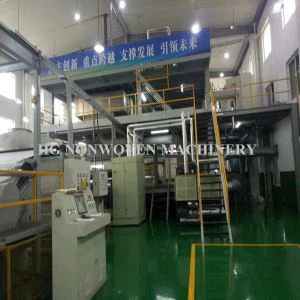
As a leading supplier of non woven fabric machinery, I've witnessed firsthand the pivotal role that rollers play in the production process. Rollers are not just simple components; they are the unsung heroes that ensure the smooth, efficient, and high - quality manufacturing of non woven fabrics. In this blog, I'll delve into the various functions and significance of rollers in non woven fabric machinery.
1. Material Conveyance
One of the primary roles of rollers in non woven fabric machinery is to convey materials through the production line. Non woven fabric production involves multiple stages, from the feeding of raw materials to the final winding of the finished fabric. Rollers act as the conveyors that move the materials steadily and precisely from one processing unit to another.
For example, in the initial stage of a PP Spun Bond Fabric Making Machine, rollers are used to transport the polypropylene (PP) chips from the hopper to the extruder. These rollers need to have a consistent speed and a firm grip on the chips to prevent any blockages or uneven feeding. If the rollers fail to convey the materials properly, it can lead to disruptions in the extrusion process, resulting in inconsistent fiber formation and ultimately, a lower - quality non woven fabric.


Similarly, during the web formation and bonding processes, rollers are responsible for moving the fiber web through different zones, such as the cooling zone and the bonding zone. They ensure that the web maintains a uniform tension and speed, which is crucial for achieving a homogeneous fabric structure.
2. Web Formation and Alignment
Rollers also play a crucial role in web formation and alignment. In the spunbonding process, for instance, the extruded filaments are laid down on a moving conveyor belt to form a fiber web. Rollers are used to control the speed and direction of the conveyor belt, which directly affects the orientation and distribution of the fibers in the web.
Proper alignment of the fiber web is essential for the mechanical properties of the non woven fabric. Rollers can be adjusted to ensure that the web is centered and straight as it moves through the production line. This helps to prevent issues such as edge curling or uneven thickness in the final fabric.
Moreover, some rollers are designed with special surface patterns or textures to enhance the web formation process. For example, textured rollers can create a certain degree of entanglement between the fibers, improving the cohesion and strength of the web.
3. Bonding and Calendering
Bonding is a critical step in non woven fabric production, and rollers are key components in this process. There are different bonding methods, such as thermal bonding, chemical bonding, and mechanical bonding, and rollers are used in each of these methods in various ways.
In thermal bonding, heated rollers are used to fuse the fibers together. The temperature and pressure applied by these rollers need to be precisely controlled to achieve the desired bonding strength. If the temperature is too low, the fibers may not bond properly, resulting in a weak fabric. On the other hand, if the temperature is too high, the fibers may melt excessively, causing damage to the fabric structure.
Calendering is another process that involves rollers. Calender rollers are used to compress and smooth the non woven fabric after bonding. They can improve the surface finish of the fabric, reduce its thickness, and enhance its density and strength. By adjusting the gap between the calender rollers and the pressure applied, manufacturers can achieve different levels of compaction and smoothness in the final product.
4. Winding and Finishing
Once the non woven fabric is produced, rollers are used for winding it onto a roll for storage and transportation. The winding process requires precise control to ensure that the fabric is wound evenly and tightly. Rollers are used to apply the appropriate tension to the fabric during winding, preventing wrinkles, folds, or loose winding.
In addition to winding, rollers can also be used for finishing operations, such as embossing and slitting. Embossing rollers are engraved with a specific pattern, and when they come into contact with the non woven fabric under pressure, they create a decorative or functional pattern on the fabric surface. Slitting rollers, on the other hand, are used to cut the wide - width non woven fabric into narrower rolls of the desired width.
5. Quality Control
Rollers also contribute to quality control in non woven fabric production. By monitoring the performance of the rollers, manufacturers can detect potential issues in the production process early on. For example, if a roller is worn out or damaged, it may cause uneven pressure or speed variations, which can be reflected in the quality of the fabric.
Regular inspection and maintenance of the rollers are essential to ensure their optimal performance. This includes checking for any signs of wear, corrosion, or misalignment. By replacing worn - out rollers in a timely manner, manufacturers can avoid costly production downtime and ensure the consistent quality of their non woven fabrics.
6. Compatibility with Different Fabrics and Processes
As a supplier of non woven fabric machinery, we understand that different types of non woven fabrics require different roller configurations. For example, a PP Spunboned Nonwoven Fabric Making Machine may need rollers with a different surface material and hardness compared to a machine used for producing melt - blown non woven fabrics.
Rollers also need to be compatible with different production processes. Some processes may require high - temperature rollers, while others may need rollers with special anti - static properties. Our company offers a wide range of rollers that are designed to meet the specific requirements of different non woven fabric applications.
Contact for Purchase and Negotiation
If you are in the market for high - quality non woven fabric machinery, including rollers and other essential components, we are here to assist you. Our team of experts has extensive experience in the non woven industry and can provide you with customized solutions based on your specific needs. Whether you are looking for a Polypropylene Nonwoven Fabric Making Machine or need to upgrade your existing equipment, we can offer you the best products and services.
Don't hesitate to reach out to us for more information and to start the negotiation process. We are committed to helping you achieve the highest level of efficiency and quality in your non woven fabric production.
References
- "Nonwoven Fabric Handbook" - A comprehensive guide on non woven fabric production techniques and machinery.
- Industry research reports on non woven fabric manufacturing processes and the role of key components.
- Technical papers from leading non woven fabric machinery manufacturers on roller design and performance.