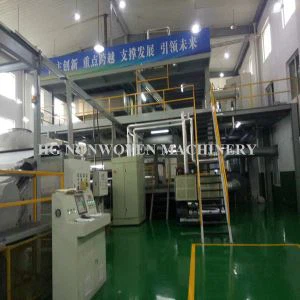
Hey there! As a supplier of nonwoven fabric machines, I often get asked about the thickness range that our machines can produce. It's a super important question, especially for businesses looking to get into the nonwoven fabric industry or expand their existing production capabilities.
First off, let's talk a bit about nonwoven fabrics. Nonwoven fabrics are made by bonding or interlocking fibers together, rather than weaving or knitting them like traditional textiles. This process gives nonwoven fabrics unique properties, such as high strength, good absorbency, and excellent durability, which makes them suitable for a wide range of applications, from medical and hygiene products to geotextiles and automotive interiors.
Now, back to the main question: what's the thickness range of nonwoven fabrics that a machine can produce? Well, the answer isn't straightforward because it depends on several factors, including the type of machine, the raw materials used, and the specific production process.
Types of Nonwoven Fabric Machines
We offer different types of nonwoven fabric machines, each capable of producing nonwoven fabrics within a certain thickness range.
Nonwoven Fabric Production Line
Our Nonwoven Fabric Production Line is a comprehensive setup that can handle various production processes. Generally, it can produce nonwoven fabrics with a thickness ranging from as thin as 10 grams per square meter (gsm) to as thick as 300 gsm. The thinner fabrics are often used in applications like disposable medical masks and wipes, where a lightweight and breathable material is required. On the other hand, the thicker fabrics can be used for things like insulation materials or heavy - duty geotextiles.
SS Non Woven Fabric Machine
The SS Non Woven Fabric Machine is designed to produce spun - bonded nonwoven fabrics. This type of machine is quite versatile and can produce fabrics with a thickness range of approximately 15 gsm to 250 gsm. The SS process creates fabrics with a uniform structure and good strength. Thinner SS nonwoven fabrics are commonly used in the production of baby diapers and feminine hygiene products, while the thicker ones can be used in the construction of protective clothing or filtration systems.
PP Spunbond Nonwoven Fabric Machinery
Our PP Spunbond Nonwoven Fabric Machinery is specialized in producing polypropylene (PP) spunbond nonwoven fabrics. These machines can produce fabrics with a thickness that typically falls between 20 gsm and 200 gsm. PP spunbond nonwoven fabrics are known for their high tensile strength and resistance to moisture. Thinner PP spunbond fabrics are used in packaging materials, while the thicker ones are suitable for automotive upholstery and agricultural covers.
Factors Affecting the Thickness Range
Raw Materials
The type and quality of raw materials play a significant role in determining the thickness of the nonwoven fabric. For example, using finer fibers can result in a thinner fabric, while coarser fibers can produce a thicker one. Different polymers also have different properties, which can affect the fabric's thickness and other characteristics.
Production Process Parameters
Parameters such as the speed of the production line, the temperature during processing, and the pressure applied can all influence the thickness of the nonwoven fabric. For instance, increasing the speed of the production line may result in a thinner fabric, while adjusting the temperature can change the bonding strength between the fibers, which in turn can affect the fabric's density and thickness.
Applications Based on Thickness
Ultra - Thin Nonwoven Fabrics (10 - 30 gsm)
These ultra - thin fabrics are mainly used in applications where a lightweight and breathable material is essential. We often see them in disposable medical products, like surgical gowns and face masks, as well as in personal care products such as baby wipes and adult incontinence pads.
Thin to Medium Nonwoven Fabrics (30 - 100 gsm)
This range of thickness is very popular for a variety of applications. In the hygiene industry, they are used in the inner layers of diapers and sanitary napkins. In the packaging industry, these fabrics can be used as wrapping materials to protect delicate items. They are also used in some filtration applications, as they can provide a good balance between filtration efficiency and air permeability.
Medium to Thick Nonwoven Fabrics (100 - 300 gsm)
These thicker fabrics are used for more heavy - duty applications. In the automotive industry, they can be used for interior linings, sound insulation, and carpet backing. In the construction industry, they are used as geotextiles for soil stabilization and erosion control.


Why Choose Our Machines?
Our nonwoven fabric machines are designed with the latest technology to ensure high - quality production and a wide range of thickness options. We have a team of experienced engineers who can customize the machines according to your specific requirements. Whether you need to produce ultra - thin fabrics for medical applications or thick fabrics for industrial use, we can provide you with the right solution.
If you're interested in getting into the nonwoven fabric business or looking to upgrade your existing production line, we'd love to talk to you. Our machines are not only reliable but also cost - effective, which can help you increase your production efficiency and reduce your operating costs.
Contact us today to discuss your needs and find the perfect nonwoven fabric machine for your business. We're here to support you every step of the way.
References
- "Nonwoven Fabric Handbook" by XYZ Publishing.
- Industry reports on nonwoven fabric production and applications.