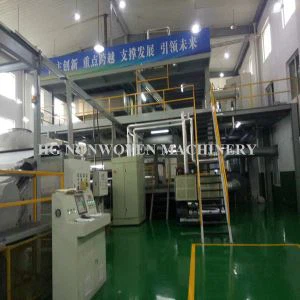
Hey there! As a supplier of Nonwoven Fabric Machines, I often get asked about the maximum production speed of high - end nonwoven fabric machines. It's a hot topic, especially for those looking to boost their production efficiency and stay competitive in the market. So, let's dive right in and explore this question.
First off, what makes a nonwoven fabric machine high - end? Well, high - end machines usually come with advanced technology, better quality components, and more precise control systems. These features allow them to produce nonwoven fabrics with better quality, higher consistency, and of course, at a faster speed.
Now, the maximum production speed of a high - end nonwoven fabric machine can vary a great deal depending on several factors. One of the most significant factors is the type of nonwoven fabric it's designed to produce. For example, machines for making spunbond nonwoven fabrics can generally achieve higher speeds compared to those for making melt - blown nonwoven fabrics.
Spunbond nonwoven fabric machines work by extruding molten polymer through spinnerets to form continuous filaments, which are then laid down on a conveyor belt to form a web. These machines are known for their relatively high production speeds. A high - end SMS Spunbond Nonwoven Fabric Making Machine can reach speeds of up to 800 meters per minute or even higher in some cases. That's incredibly fast! At this speed, it can produce a large amount of nonwoven fabric in a short period, which is great for large - scale production.
On the other hand, melt - blown nonwoven fabric machines produce fine fibers by blowing molten polymer with high - speed hot air. The process is more complex and requires more precise control, so the production speed is usually lower. A high - end melt - blown machine might have a maximum speed of around 50 - 100 meters per minute. However, the quality of the melt - blown fabric, especially its filtration efficiency, is very high, which makes it ideal for applications like medical masks and air filters.
Another factor that affects the production speed is the width of the nonwoven fabric. Generally, wider machines can produce more fabric per unit time, but they also require more power and more advanced control systems to maintain the quality of the fabric across the entire width. For instance, a narrow - width machine might be able to run at a relatively high speed, but if you want to produce wider nonwoven fabrics, the speed might need to be adjusted to ensure uniform quality.
The quality requirements of the nonwoven fabric also play a role in determining the production speed. If you need a fabric with very high strength, low porosity, or specific surface characteristics, the machine might need to run at a slower speed to achieve these properties. In contrast, if the quality requirements are relatively low, the machine can operate at a higher speed.
Let's talk about the PP Non Woven Fabric Production Line. Polypropylene (PP) nonwoven fabrics are widely used in various industries, such as packaging, agriculture, and hygiene products. A high - end PP nonwoven fabric production line can be quite versatile. It can produce different types of PP nonwoven fabrics, from lightweight to heavy - duty ones. The production speed of such a line depends on the specific configuration and the type of fabric being produced. For lightweight PP nonwoven fabrics, the speed can be relatively high, similar to that of spunbond machines. But for heavier fabrics, the speed might be reduced to ensure proper bonding and quality.
In addition to the type of fabric and width, the raw materials used also impact the production speed. Different polymers have different melting points, viscosities, and flow properties. For example, some polymers might flow more easily through the spinnerets, allowing the machine to run at a higher speed. If the raw material has impurities or inconsistent quality, it can cause blockages or uneven fiber formation, which will slow down the production process.
Now, let's consider the market demand for nonwoven fabrics. With the increasing demand for products like face masks, especially during the COVID - 19 pandemic, the need for high - speed nonwoven fabric production has become even more crucial. Many manufacturers are looking for machines that can produce nonwoven fabrics at a faster rate without sacrificing quality. That's where high - end nonwoven fabric machines come in. They can help manufacturers meet the market demand more efficiently and increase their profit margins.


Take the Printed PP Nonwoven Fabric For Children Face Mask as an example. This type of fabric not only needs to have the right filtration and comfort properties but also needs to be printed with attractive designs for children. High - end machines can handle both the production of the base nonwoven fabric and the printing process at a relatively high speed, ensuring a smooth and efficient production flow.
So, as a nonwoven fabric machine supplier, I understand that choosing the right machine with the appropriate production speed is crucial for your business. You need to consider your production requirements, the type of fabric you want to produce, and your budget. If you're looking to produce large quantities of nonwoven fabrics quickly, a high - end spunbond or PP nonwoven fabric machine might be the way to go. But if you need high - quality melt - blown fabrics for filtration applications, a melt - blown machine with the right speed and precision is essential.
If you're interested in learning more about our nonwoven fabric machines or want to discuss your specific production needs, don't hesitate to reach out. We're here to help you find the best solution for your business. Whether you're a small - scale manufacturer or a large - scale industrial player, we have the expertise and the machines to meet your requirements.
In conclusion, the maximum production speed of a high - end nonwoven fabric machine is influenced by many factors, including the type of fabric, width, raw materials, and quality requirements. By understanding these factors, you can make an informed decision when choosing a nonwoven fabric machine for your production. So, get in touch with us today and let's start this exciting journey of efficient nonwoven fabric production together!
References
- "Nonwoven Fabric Technology and Applications" by X. Chen
- "Advances in Nonwoven Materials" by A. K. Mohanty