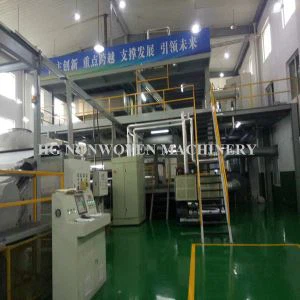
What is the water repellency of nonwoven fabrics produced by a machine?
Nonwoven fabrics have become an integral part of various industries due to their versatility, cost - effectiveness, and ease of production. As a Nonwoven Fabric Machine supplier, I am often asked about the water - repellency properties of the nonwoven fabrics produced by our machines. In this blog, we will delve into the concept of water repellency in nonwoven fabrics, the factors affecting it, and how our machines contribute to producing high - quality water - repellent nonwoven fabrics.
Understanding Water Repellency in Nonwoven Fabrics
Water repellency refers to the ability of a material to resist the penetration of water. In the case of nonwoven fabrics, it is a crucial property, especially for applications where protection from moisture is required. Nonwoven fabrics can range from being slightly water - resistant to highly water - repellent, depending on their composition, structure, and manufacturing process.
The water - repellency of nonwoven fabrics is measured using various methods. One common method is the spray rating test, where water is sprayed onto the fabric at a specific pressure and angle, and the fabric's ability to resist wetting is evaluated. Another method is the hydrostatic head test, which measures the maximum height of water column that the fabric can withstand without allowing water to penetrate.
Factors Affecting Water Repellency
Fiber Type
The type of fibers used in the nonwoven fabric plays a significant role in determining its water - repellency. Synthetic fibers such as polypropylene (PP), polyethylene (PE), and polyester are naturally hydrophobic, meaning they have a low affinity for water. Nonwoven fabrics made from these fibers tend to have better water - repellency compared to those made from natural fibers like cotton, which are hydrophilic and absorb water easily.
For example, polypropylene is widely used in nonwoven fabric production due to its excellent water - repellent properties. Our Nonwoven Fabric Machine is capable of processing polypropylene fibers to produce high - quality nonwoven fabrics with good water - repellency.
Fiber Fineness
The fineness of the fibers also affects water - repellency. Finer fibers have a larger surface area per unit mass, which can lead to better water - repellency. When the fibers are finer, they can form a denser structure, making it more difficult for water to penetrate the fabric. Our machines are designed to produce nonwoven fabrics with a wide range of fiber fineness, allowing us to customize the water - repellency properties according to the customer's requirements.
Fabric Structure
The structure of the nonwoven fabric, including its porosity and density, has a direct impact on water - repellency. A fabric with a low porosity and high density will have better water - repellency as it provides more resistance to water penetration. Our Non Woven Fabric Making Machine can be adjusted to control the fabric's structure during the production process. For instance, by adjusting the bonding parameters and the fiber laying process, we can produce nonwoven fabrics with different levels of porosity and density.


Surface Treatment
Surface treatment is another important factor in enhancing the water - repellency of nonwoven fabrics. Chemical treatments such as fluorocarbon coatings or silicone - based treatments can be applied to the fabric surface to reduce its surface energy, making it more difficult for water to spread and penetrate. Our S Spunbond Nonwoven Fabric Making Machine can be integrated with surface treatment systems to apply these treatments during the production process, ensuring consistent and high - quality water - repellency.
How Our Machines Contribute to Water - Repellent Nonwoven Fabric Production
Our Nonwoven Fabric Machines are designed with advanced technology to produce nonwoven fabrics with excellent water - repellency. Firstly, our machines can process a variety of hydrophobic fibers, such as polypropylene, to create the base material with inherent water - repellent properties.
Secondly, the machines offer precise control over the fiber fineness and fabric structure. By adjusting the spinning and bonding parameters, we can produce nonwoven fabrics with the desired density and porosity, which are crucial for water - repellency.
Thirdly, our machines can be equipped with surface treatment units. These units can apply water - repellent coatings evenly on the fabric surface, enhancing its water - repellency performance. The automated nature of our machines ensures that the surface treatment is consistent across the entire fabric, resulting in high - quality products.
Applications of Water - Repellent Nonwoven Fabrics
Water - repellent nonwoven fabrics produced by our machines have a wide range of applications. In the medical industry, they are used for surgical gowns, drapes, and masks to protect healthcare workers from body fluids. In the automotive industry, they are used for car interiors, such as seat covers and headliners, to prevent water damage. In the construction industry, they are used as roofing membranes and insulation covers to protect buildings from water infiltration.
Contact for Purchase and Negotiation
If you are interested in our Nonwoven Fabric Machines and want to produce high - quality water - repellent nonwoven fabrics, we invite you to contact us. Our team of experts will be happy to provide you with detailed information about our machines, their capabilities, and how they can meet your specific production requirements. We can also offer customized solutions based on your needs.
References
- ASTM International. (2023). ASTM D5802 - 19 Standard Test Method for Hydrostatic Resistance of Nonwoven Fabrics.
- ISO. (2022). ISO 4920:2012 Textiles - Determination of resistance to water penetration - Spray test.
- Bhat, G. S., & Nadkarni, V. M. (2019). Nonwoven fabrics: Structure, properties, and applications. CRC Press.