

Choosing the Best Materials for Spunbond Nonwoven Fabric: A Professional Guide to Manufacturing
Selecting spunbond nonwoven fabric material isn't just technical-it's strategic, impacting performance, regulatory acceptability, and profitability. We've been supplying spunbond fabrics to markets ranging from medical to automotive for over 20 years and understand how material selection makes or breaks products. This guide explores the depth of polymer science, industry standards, and practical case studies to take you to the ideal material selection for your application.
Material selection is crucial.
Spunbond non-woven fabric versatility is due to its adjustable raw material. An improper selection may result in:
Product Failures: Delamination of medical gowns, degradation due to UV of agricultural covers.
Compliance Risks: Violation of FDA or REACH requirements due to prohibited additives.
Cost Overruns: Over-engineering with expensive high-end polymers for simple applications.
A 2023 survey by Nonwovens Industry Magazine found that 45% of all fabric defects are caused by poor material selection. Let's turn that around.
Major Considerations When Choosing Spunbond Materials
1. Application Requirements
Medical: ISO 10993 biocompatibility, liquid barrier (AAMI Level 4
Agriculture: Resistant to UV (500+ hours ASTM G154), high tear strength (>40 N
Packaging: Recyclability (GRS certification), printability.
2. Performance Metrics
Tensile Strength: 15 N/5cm (10 gsm) to 120 N/5cm (150 g
Thermal stability: Polypropylene (PP) melts at 160°C compared to polyester (PET) at 250
Hydrophilicity: Critical for hygiene products (tests: AATCC 79).
3. Regulatory Compliance
Food Contact: FDA 21 CFR 177.1520 for PP.
EU Compliance: SVHC-free under REACH, RoHS compliant for
Flame Retardancy: EN 13501-1 (construction) vs. NFPA 701 (USA).
4. Cost Efficiency
Virgin PP
1.30
–
1.30–1.80/kg.
Reprocessed PP
0.90
–
0.90–1.20/kg (10–20% lower strength).
PET: 25–40% pricier than PP but more durable.

Best Material Options for Spunbond Nonwoven Fabric
1. Polypropylene (PP) – The Industry Standard
Pros
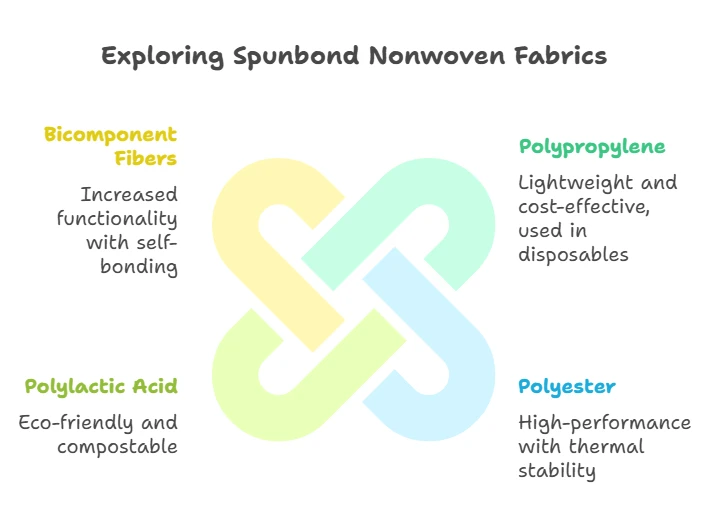
Lightweight (0.91 g/cm³ density).
Chemically inert (acid and base resistant).
Cost-effective (60% of global spunbond production).
Cons
Low melting point (160–170°C
UV degradation without stabilizers.
Best For: Disposable medical gowns, shopping bags, and diaper liners.
Case History: An American medical distributor reduced gown prices by 22% by switching from PET to PP with UV stabilizers for surgical drapes.
2. Polyester (PET) – High-Performance Option
Pros
High tensile strength (up to 50% greater than PP).
Thermal stability (250°C
Improved UV stability (weatherability of 1,000+
Cons
Increased density (1.38 g/cm³) increases the price of
Coarsely textured unless blended.
Best For: Geotextiles, automotive interiors, and roofing membranes
Pro Tip: PET spunbond laminated with PVC is being used as convertible car roofs by BMW and Mercedes.
3. PLA (Polylactic Acid) – An Eco-Friendly Benefits
Compostable (EN 13432 certified).
Produced from cornstarch or sugarcane
Cons
Low heat tolerance (60°C max).
3x higher cost than PP.
Best For: Organic body products, one-use biodegradable packaging.
Industry Insight: PLA use is growing 18% annually in the EU due to the Single-Use Plastics Directive.
4. Bicomponent Fibers – Increased Functionality
Structure: Core-sheath (i.e., PET core + PP sheath) or side-by
Benefits
Self-bonding (reduces need for adhesives).
Custom-designed melting temperatures for thermal bonding.
Additives & Modifiers: Tailoring Material Properties
| Additive | Function | Application Example |
|---|---|---|
| TiO2 Nanoparticles | UV resistance | Agricultural crop covers |
| Silver Ions | Antimicrobial (AATCC 100) | Surgical masks, wound dressings |
| Carbon Black | Conductive properties | EMI shielding fabrics |
| Hydrophilic Agents | Water absorption | Baby diapers, feminine hygiene |
| Flame Retardants | Self-extinguishing | Aircraft seat covers (FAR 25.853) |
Caution: Some additives (e.g., phthalate plasticizers) are restricted under EU REACH.
Sustainable Material Developments
1. Reused Polym
Post-consumer PP: From bottle caps and packaging.
Requires compatibilizers to be compatible with virgin PP.
Post-industrial PET: From textile waste, trimmed to 1–5 mm flakes.
Certifications
GRS (Global Recycled Standard): 20% minimum recycled.
SCS Recycled Content Certification
2. Bio-Based Polym
PP from Sugarcane: Braskem's Green PP (reduces carbon footprint by 70%).
Castor Oil-Based PA11: For high performance automotive applications.
3. Circular Design
Take-back programs: Partner with customers to recycle end-of-use nonwovens.
Monomaterials: Remove the use of mixed polymers (e.g., 100% PP
Material Testing and Quality Assurance
1. In-house Lab Tests
Melt Flow Index (MFI): ASTM D1238 (preferable range for PP: 25–35 g/10
DSC analysis determines polymer crystallinity (which affects bonding strength).
FTIR Spectroscopy: Checks polymer degradation or impurities.
2. Third-Party Certification
ISO 9001: Quality management.
ISO 14001: Environmental Compliance.
OEKO-TEX Standard 100: Free from
Case Study: A German automotive customer rejected one 10-ton PET batch due to non-uniform MFI-resolved by optimizing extrusion QC protocols.
Cost vs. Performance: Decision Framework
Use this matrix to prioritize materials:
| Scenario | Recommended Material | Cost per kg | Key Benefit |
|---|---|---|---|
| Budget-conscious packaging | Virgin PP + 20% recycled | $1.10 | Balance cost & sustainability |
| High-temperature filtration | PET with SiO2 coating | $2.80 | Heat resistance |
| Biodegradable food wraps | PLA + starch modifiers | $3.50 | Compostability |
| Flame-retardant uniforms | PP + ammonium polyphosphate | $1.90 | Self-extinguishing |
FAQ
Q: Can we blend recycled and virgin PP?
A: Yes-up to 50% recycled PP without significant strength loss. Add 2–5% elastomer compatibilizers.
Q: How do I verify polymer quality?
A: Request Certificate of Analysis (CoA) with MFI, ash content, and additive details.
Q: What's the MOQ for custom additives?
A: Typically 5 tons, but trial batches (1 ton) are possible with surcharges.
Q: Is PLA suitable for humid climates?
A: No-PLA absorbs moisture, causing hydrolysis. Use desiccant packaging during shipping.
Why Partner with Us?
Material Library: 50+ polymers and additives pre-tested for spunbond.
R&D Support: Free consultation on material selection for your application.
Global Compliance: Pre-certified batches for FDA, REACH, OEKO-TEX®.


